
Energy Efficient and Green Home Design
At Riverside Home Designs, we believe that energy-efficient and green building practices are essential to creating comfortable, sustainable homes that serve their owners well for decades. Our approach to green design integrates passive solar principles, superior insulation systems, proper building orientation, and sustainable materials to minimize energy consumption while maximizing comfort and livability.
With over 40 years of experience designing energy-efficient homes for the Texas Hill Country, we understand how to work with local climate conditions, building challenges, and sustainable practices to create homes that are both environmentally responsible and economically efficient to operate.
Our Green Design Approach
Energy efficiency isn't achieved through a single technology or material—it requires a comprehensive, integrated approach that considers the entire building system. Our core architectural design services focus on:
- Passive Solar Design: Optimal window placement and home orientation to maximize solar gain in winter and minimize heat gain in summer
- Proper Insulation: Spray foam insulation (open and closed cell), SIPs, and strategic placement for maximum thermal resistance
- Air Sealing: Comprehensive air sealing to eliminate drafts and uncontrolled air leakage
- Sustainable Materials: Selection of low-toxicity, renewable, and recycled-content materials where possible
While Quality HVAC Design and Water Management Systems are not included as standard services in our architectural design packages, we can assist with design criteria and coordinate with specialized engineers and contractors to integrate these systems into your home's overall design.
Spray Foam Insulation
Spray foam insulation has revolutionized the building industry by providing superior insulating performance, air sealing, and moisture control properties compared to traditional insulation materials like fiberglass and cellulose. We are strong advocates for spray foam technology because of its documented energy-saving benefits and structural advantages.
Why Spray Foam?
Spray foam insulation offers unique advantages over conventional insulation materials:
- Superior R-value per inch of thickness
- Provides complete air barrier when properly installed
- Seals irregular surfaces and cavities completely
- Adds structural rigidity to walls and roofs
- Eliminates thermal bridging common with other insulation
- Long-term performance without settling or degradation
- Excellent moisture control properties
The Science of Spray Foam Blowing Agents
Spray foam insulation is created by mixing two chemical components that react to form cellular plastic. The "blowing agent" is what creates the foam structure. There are primarily two types: open cell foam typically uses water as the blowing agent, while closed cell foam historically used CFC and HCFC compounds, and now primarily uses hydrofluoroolefin (HFO) compounds.
Water as a blowing agent for open cell foam is an excellent environmentally-friendly option with zero ozone depletion potential and very low global warming potential. Open cell foams blown with water typically achieve R-3.6 to R-4.0 per inch.
Closed cell foams use more sophisticated blowing agents like Enovate (245fa) or newer HFO compounds. Every major closed cell foam on the market uses water AND Enovate (245fa), which is exclusively manufactured by Honeywell, making it a lucrative product with significant marketing behind it. Closed cell foams achieve R-6.3 to R-6.5 (aged values) per inch.
It's important to note the difference between "initial R-values" and "aged R-values." Many manufacturers advertise initial R-values which gradually decline over time. If you see a foam advertised with exceptionally high R-values, verify whether these are initial or aged values for accurate comparison.
Open Cell vs. Closed Cell Spray Foam
What Does Open Cell and Closed Cell Mean?
When spray foam is installed in a home, a cellular plastic is created on site through chemical reaction. Think of it as bubbles in a bubble bath—millions of tiny air-filled cells that cure very quickly.
Open Cell Foam: In open cell foam, the majority of the millions of bubbles share walls with one another, making it soft and airy. Only a few percent of the finished product is plastic; the rest is mostly carbon dioxide trapped within the structure. Open cell foams are light, typically weighing 0.5-0.6 pounds per cubic foot. The industry definition is that greater than 50% of cells are open.
Closed Cell Foam: In closed cell foam, the majority of cells are independent structures that do not share cell walls. This results in much higher plastic content and less air/gas content. The foam is strong and rigid, typically weighing 1.7-2.0 pounds per cubic foot. The industry definition is that greater than 90% of cells are closed.
Key Differences for Homeowners, Builders, and Architects
There are three major differences between open and closed cell spray foam:
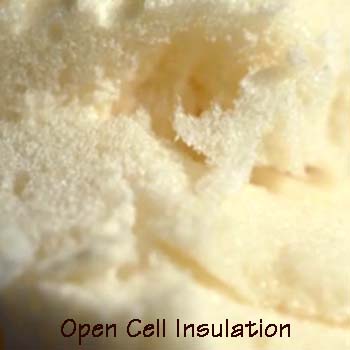
Open Cell Foam
R-Value: R-3.6 to R-4.0 per inch
Best For: Applications where space is not limited, such as attics and crawl spaces
Cost: Less expensive per R-value
Air Barrier: Yes—despite its name, open cell foam is an effective air barrier
Moisture Permeability: Semi-permeable (10 perms at 5" depth)
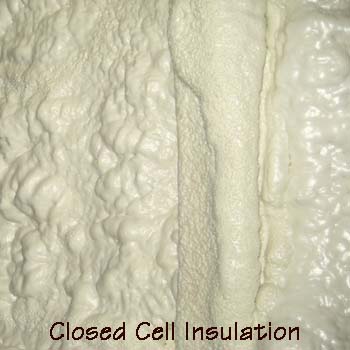
Closed Cell Foam
R-Value: R-6.3 to R-6.5 (aged) per inch
Best For: Applications requiring high R-values in shallow spaces
Cost: More expensive per R-value than open cell
Air & Moisture Barrier: Excellent barrier properties
Moisture Permeability: Semi-impermeable (less than 1 perm at 2")
Closed cell foam is always more expensive per R-value because plastic costs more than air. You would expect R-13 of closed cell to be more expensive than R-13 of open cell. The choice between open and closed cell depends on your specific project requirements, available space, and performance goals.
Moisture Permeability and Building Science
Understanding Vapor Permeance
Moisture permeability is measured in "perms" and represents how much moisture can move through a given material. The higher a perm rating, the greater the amount of moisture that can pass through the material. Understanding vapor permeance is critical to designing moisture-resistant building assemblies.
Fiberglass Insulation
Rating: Vapor Permeable
Much Greater Than 20 perms
Cellulose Insulation
Rating: Vapor Permeable
Much Greater Than 20 perms
Open Cell Spray Foam
Rating: Vapor Semi-Permeable
10 perms at 5" depth
Closed Cell Spray Foam
Rating: Vapor Semi-Impermeable
Less than 1 perm at 2"
Fiberglass and cellulose are often installed with polyethylene vapor barriers (6 mm plastic) or kraft-faced insulation. Polyethylene will make the assembly semi-impermeable, while kraft facing makes it semi-permeable.
Acceptable Building Design Principles
System-Based Approach to Moisture Control
A building consists of thousands of combinations of materials to construct wall and roof assemblies. Each material has specific vapor permeance characteristics, and the assembly as a whole must be evaluated for moisture control capability, considering both the expected interior and exterior weather conditions.
The general rule of thumb with moisture is: Keep it out of building assemblies, but when it gets in, make sure it has a way out. Most building science experts recommend a "flow-through design" that allows moisture to move toward the exterior in winter and the interior in summer. This dynamic approach works well in mixed climates like ours in the Texas Hill Country.
Conclusion
Both open and closed cell spray foam are exceptional products that significantly outperform all competing insulation materials. You can use either product with confidence in appropriate applications. However, every structure is unique, and special attention must be given to the moisture and air permeability properties of your ENTIRE wall and roof assemblies to ensure they can accept and release moisture properly, avoiding degradation of the structure and associated problems.
Our design team considers these factors comprehensively to create energy-efficient homes that perform well for decades while maintaining structural integrity and indoor air quality.
Other Green Building Technologies
Beyond spray foam insulation, Riverside Home Designs incorporates multiple green building strategies:
Structurally Insulated Panels (SIPs)
SIPs combine foam insulation with oriented strand board (OSB) facing, providing both insulation and structural support in a single component. SIPs reduce thermal bridging, create airtight assemblies, and speed construction.
Passive Solar Design
We can incorporate passive solar design strategies into your home, optimizing window placement and overall orientation relative to the sun. By using appropriate overhangs, shading, and thermal mass, we help maximize winter solar gain while minimizing summer heat gain—reducing heating and cooling loads naturally.
Water Management Systems
We are able to design for sustainable water management solutions, including rainwater harvesting systems, greywater recycling, and on-site drainage strategies. These options can help reduce municipal water demand and manage stormwater more effectively.
Solar Integration
We can design your home to accommodate rooftop solar panels with the proper structural support, electrical considerations, and aesthetic integration. This ensures that solar equipment fits seamlessly into the architecture and long-term functionality of the home.