Energy efficiency has become one of the defining priorities of modern residential and light commercial construction. Rising energy costs, increased environmental awareness, stricter building codes, and higher homeowner expectations have fundamentally changed how buildings are designed and constructed. Today, energy efficiency is no longer an optional upgrade—it is a core performance requirement.
Among the many components that influence a building's energy performance, insulation plays one of the most critical roles. In particular, spray foam insulation, both open-cell and closed-cell, has emerged as a leading solution for creating high-performance building envelopes. Understanding how these systems work, where they are best applied, and how they contribute to long-term energy savings is essential for anyone building a custom home in Kerrville or throughout the Texas Hill Country.
Why Energy Efficiency Matters in Today's Buildings
Modern construction emphasizes efficiency for several key reasons:
- Reduced operating costs: Energy-efficient buildings consume less electricity and fuel, lowering monthly utility expenses.
- Improved comfort: Better insulation and air sealing reduce drafts, temperature swings, and hot or cold spots.
- Durability and moisture control: Controlling air and moisture movement protects structural components from long-term damage.
- Code compliance: Energy codes such as the International Energy Conservation Code (IECC) continue to raise minimum performance standards.
- Resale value: Energy-efficient homes are increasingly attractive to buyers and appraisers.
At the heart of all these benefits is the building envelope—the walls, roof, floors, and openings that separate conditioned interior space from the exterior environment.
The Building Envelope: Air, Heat, and Moisture Control
Heat loss and heat gain occur through three primary mechanisms:
- Conduction: Heat moving through solid materials.
- Convection: Heat carried by moving air.
- Radiation: Heat transferred through electromagnetic waves.
Traditional insulation materials, such as fiberglass batts or blown cellulose, primarily address conduction. However, they do little to stop air movement, which is often the largest source of energy loss in a building.
Spray foam insulation addresses both insulation and air sealing simultaneously, making it uniquely effective in modern construction—especially important for custom homes in Fredericksburg and other Hill Country locations where temperature extremes demand superior building performance.
Spray Foam Insulation Overview
Spray foam insulation is a two-component material that expands when applied, filling cavities, cracks, and irregular spaces. Once cured, it forms a continuous insulation and air barrier.
There are two primary types used in residential and light commercial construction:
- Open-cell spray foam
- Closed-cell spray foam
While both provide excellent performance, they differ significantly in structure, properties, and ideal applications.
Open-Cell Spray Foam Insulation
Characteristics
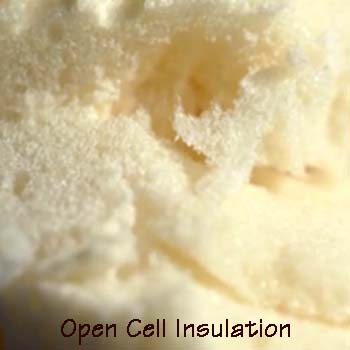
Open-cell spray foam has a softer, sponge-like structure. The cells within the foam are not completely sealed, allowing some air movement within the material itself.
Key characteristics include:
- Lower density (approximately 0.5 lb per cubic foot)
- R-value of approximately R-3.5 to R-3.7 per inch
- Excellent air sealing capability
- High sound absorption
- Vapor permeable
Energy Efficiency Benefits
Open-cell foam excels at air sealing, which is critical for reducing energy loss. By eliminating uncontrolled air infiltration and exfiltration, heating and cooling systems operate more efficiently and consistently.
Because it expands aggressively, open-cell foam is particularly effective at filling irregular framing cavities and hard-to-reach areas, ensuring a continuous air barrier.
Common Applications
- Interior wall cavities
- Rooflines and attic slopes (unvented attic assemblies)
- Sound-control partitions
- Climate-controlled spaces where vapor diffusion is acceptable
Open-cell foam is frequently used in hot and mixed climates like the Texas Hill Country, where vapor permeability can help assemblies dry toward the interior when properly designed.
Closed-Cell Spray Foam Insulation
Characteristics
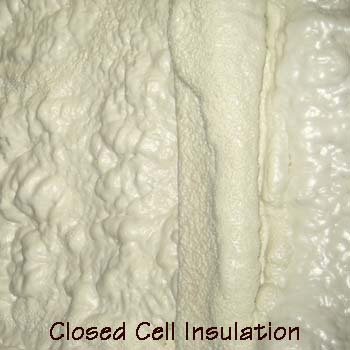
Closed-cell spray foam has a much denser structure, with cells that are fully encapsulated and filled with a blowing agent. This results in higher strength and thermal resistance.
Key characteristics include:
- Higher density (approximately 2 lb per cubic foot)
- R-value of approximately R-6 to R-7 per inch
- Excellent air barrier
- Low vapor permeability
- Adds structural rigidity
- Acts as a moisture barrier
Energy Efficiency Benefits
Because of its high R-value per inch, closed-cell foam delivers superior thermal performance in limited space conditions. Its ability to serve as insulation, air barrier, and vapor retarder in a single product makes it extremely effective for high-performance building envelopes.
Closed-cell foam also reduces thermal bridging and limits moisture intrusion, both of which directly impact long-term energy efficiency.
Common Applications
- Exterior wall assemblies
- Crawl spaces and basements
- Roof decks and unvented attic systems
- Metal buildings
- Areas prone to moisture exposure
In regions with high humidity or where space constraints exist, closed-cell foam is often the preferred solution for custom homes in Boerne and throughout the Hill Country.
Open-Cell vs. Closed-Cell: Choosing the Right System
Selecting between open-cell and closed-cell spray foam is not a matter of "better" or "worse," but rather appropriateness for the application.
| Factor | Open-Cell | Closed-Cell |
|---|---|---|
| R-value per inch | Moderate (R-3.5–3.7) | High (R-6–7) |
| Air sealing | Excellent | Excellent |
| Vapor control | Permeable | Low permeability |
| Structural contribution | Minimal | Significant |
| Sound absorption | Very good | Moderate |
| Cost | Lower | Higher |
Design Tip
In many high-performance designs, both types are used strategically within the same building to optimize cost, performance, and moisture control. At Riverside Home Designs, we work with you to determine the best insulation strategy for your specific project requirements.
Energy Efficiency Beyond R-Value
While R-value is often the most discussed insulation metric, modern energy-efficient construction looks beyond simple thermal resistance.
Spray foam insulation contributes to:
- Reduced HVAC system sizing: Lower heating and cooling loads allow for smaller, more efficient mechanical systems.
- Improved indoor air quality: Reduced infiltration limits dust, pollen, and outdoor pollutants.
- Consistent interior temperatures: Eliminating air leakage improves comfort across rooms and floors.
- Long-term durability: Controlled moisture movement protects framing, sheathing, and finishes.
These factors collectively improve real-world energy performance far more than insulation thickness alone.
Code Compliance and Modern Standards
Energy codes increasingly recognize the value of air sealing and continuous insulation. Spray foam systems are commonly used to meet or exceed:
- IECC air leakage requirements
- Performance-based energy compliance paths
- Net-zero and high-efficiency design targets
- Energy Star certification requirements
Proper installation is critical. Spray foam must be applied by qualified professionals and integrated with the overall building envelope strategy, including ventilation, moisture management, and mechanical design.
Long-Term Value and Sustainability
From an economic standpoint, spray foam insulation often carries a higher upfront cost compared to traditional materials. However, the lifecycle cost analysis frequently favors spray foam due to:
- Lower energy bills
- Reduced maintenance issues
- Longer system lifespan
- Increased property value
From a sustainability perspective, reduced energy consumption directly lowers greenhouse gas emissions over the life of the building. Our commitment to sustainable design aligns with U.S. Green Building Council standards, promoting environmentally responsible building practices.
Conclusion
Energy efficiency in modern construction is no longer achieved through isolated upgrades—it requires a holistic approach to design, materials, and execution. Open-cell and closed-cell spray foam insulation play a central role in this approach by addressing not only thermal resistance, but also air sealing, moisture control, and overall building performance.
When properly specified and installed, spray foam insulation helps create buildings that are more comfortable, more durable, and significantly more energy-efficient. As energy codes tighten and expectations rise, understanding and leveraging these insulation systems has become an essential component of responsible, forward-thinking construction.
Whether you're planning a custom home in Kerrville, Comfort, Bandera, or anywhere in the Texas Hill Country, our team can help you design an energy-efficient home that meets your performance goals and budget.